HarmonyIQ
Turned a contract creation brief into a full AI financial intelligence platform.
0
End-to-end contract stages
0
Audit cycle reduction
0
Personas unified
0
Blind negotiations
01 · The Brief
A complex problem. Properly articulated.
Provider contract management at a large US health plan is not a simple workflow. Contract managers are responsible for negotiating reimbursement rates with hundreds of providers across multiple markets. Each negotiation has financial, compliance, and network adequacy implications.
The client knew the problem was significant. Through discovery sessions, stakeholder interviews, SME walkthroughs, and close observation of how contract teams actually spent their days, we mapped the full shape of it together and agreed on what needed to be built.
The process was fragmented end to end. Proposals drafted in Word. Rate decisions made without competitor benchmarks. Renewal data scattered across three disconnected systems, taking days to pull together. Approvals tracked over email with no structured flow and no visibility.
02 · Discovery
Five stages. Five different broken systems.
The discovery sessions gave us a clear picture of where time and accuracy were being lost. Each stage of the contract lifecycle had its own friction. Together, they added up to a process that was slower, riskier, and more expensive than it needed to be.
The design question we landed on: "How do we make contract managers more confident and informed at every decision point, from first proposal to final signature?"
Rate decisions without benchmarks
Contract managers proposed reimbursement rates with no visibility into what peer payers were offering.
Word docs, email chains, spreadsheets
Proposals drafted in Word, tracked in Excel, iterated over email. No version control. No audit trail.
Renewal data across three systems
Claims history, member trends, quality scores—all in separate systems. Days of manual gathering.
Silent financial leakage
Without alignment between contract terms and actual claims, providers were being reimbursed incorrectly.
Approvals with no structure
Stakeholders chased each other over email. No flow. No timestamps. No accountability.
03 · Architecture
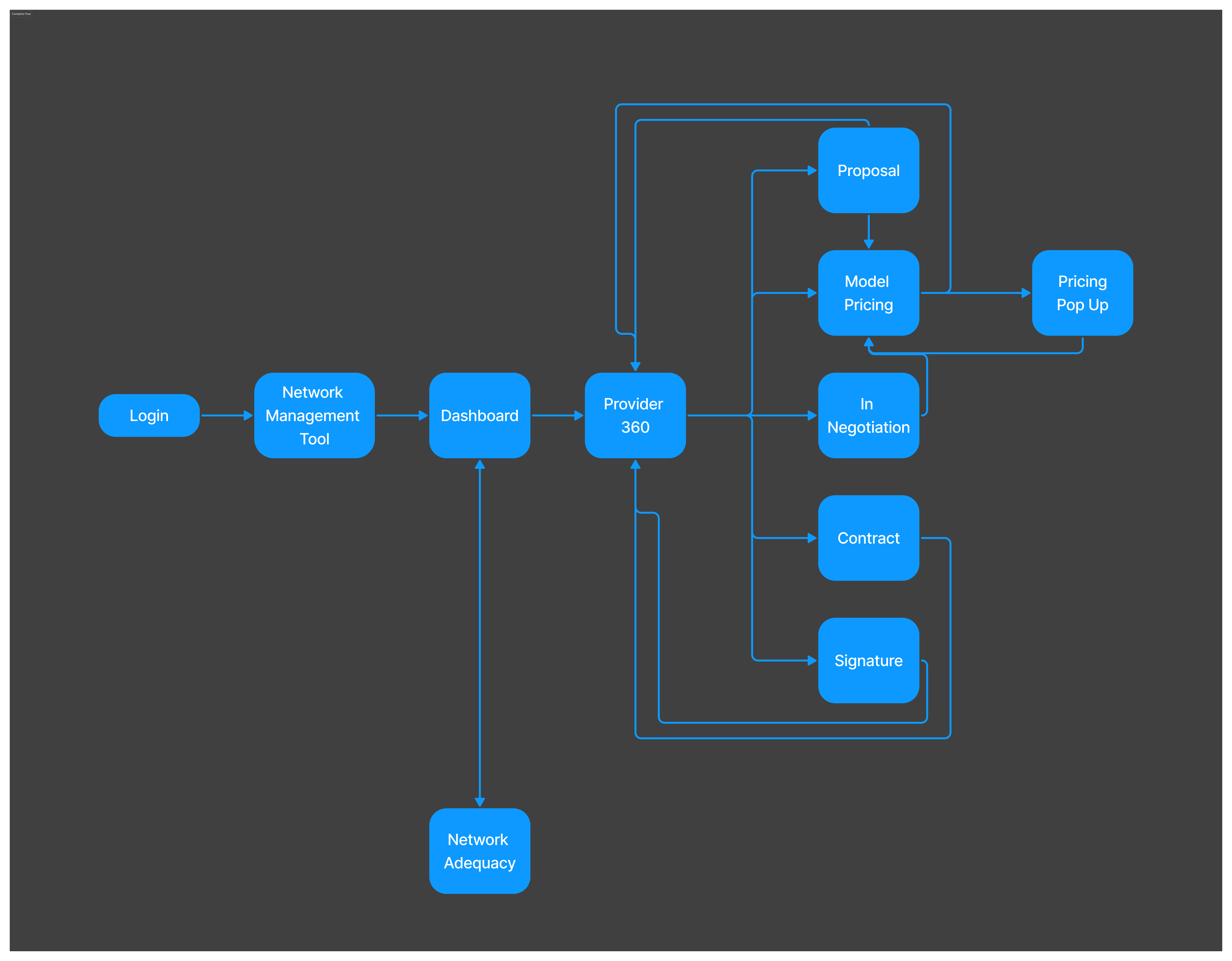
Mapping the full contract lifecycle.
Before any UI was designed, I mapped the complete system architecture. The user flow diagram became the primary alignment artifact for the team and stakeholders as scope expanded.
The three personas
Contract Manager
Needs confidence and benchmarks. Goes into every negotiation knowing what competitors are paying and what the AI recommends.
Compliance Lead
Needs a complete audit trail and structured approval flow. Every edit, every decision, every version timestamped and traceable.
Provider Relations
Needs visibility without chasing anyone. Where is this contract? Who has it? All visible in one place.
"The discovery process defined the product. Understanding the full shape of the problem, together with the client, is what made it possible to design something that actually solved it."
04 · The Design
Five stages. AI at every decision point.
Every stage was designed around a single principle: the contract manager should always know what to do next, and why. I led the design across all five stages with two junior designers supporting execution.
Screen 01
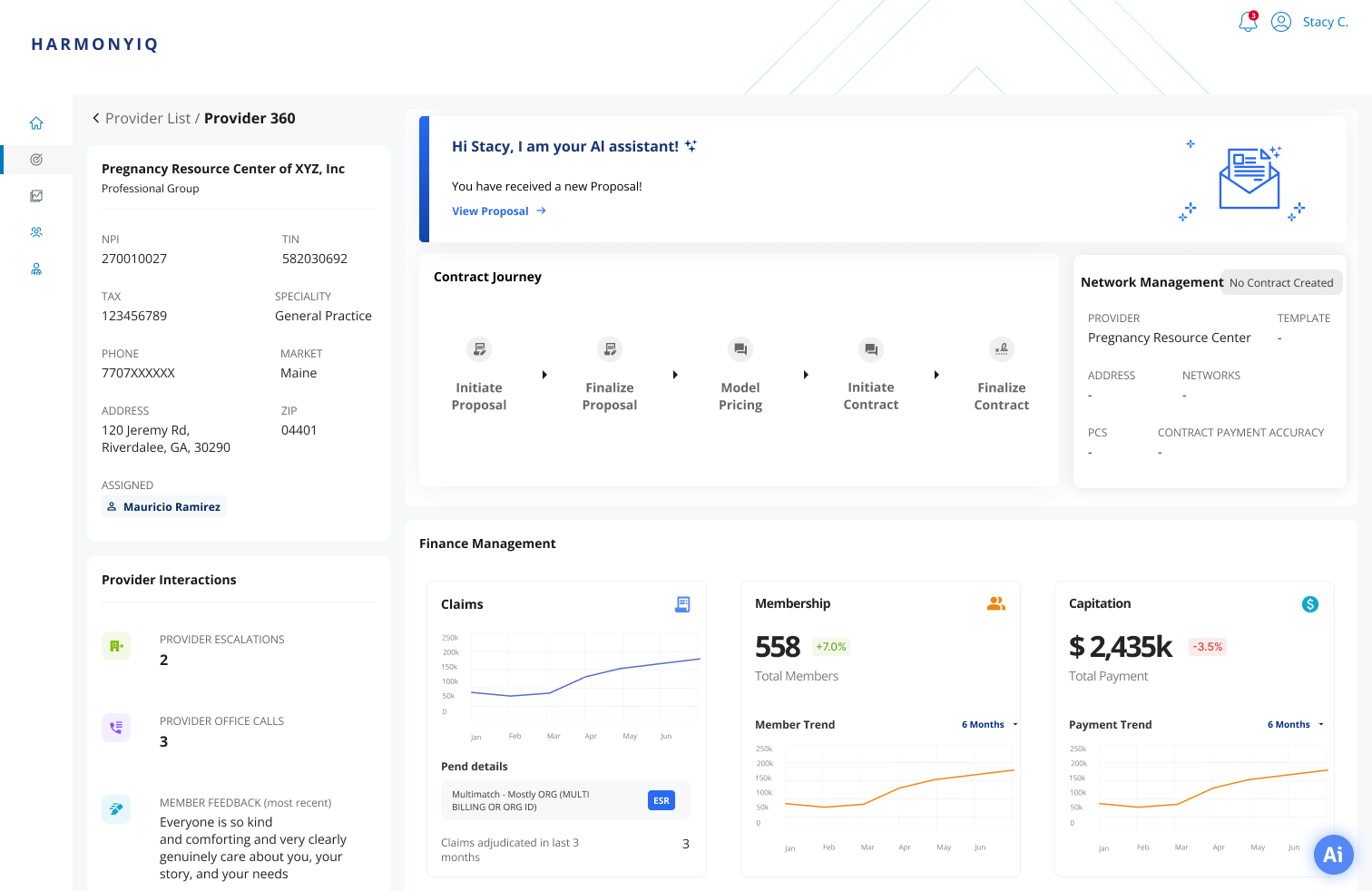
Provider 360
Every negotiation starts here. Before a contract manager initiates a proposal, they see the provider's full profile: AI-generated alerts, the complete contract journey tracker, financial relationship data, and interaction history.
AI Proactive Alerts
The AI surfaces what needs attention before the manager asks.
Contract Journey Tracker
Every provider's contract stage visible at a glance.
Provider Interactions
Escalations, office calls, and member feedback surfaced in context.
Screen 02
Initiate Proposal
The proposal editor is designed around how contract managers actually work. A structured document with embedded rate tables sits alongside the AI Insights panel, surfacing a recommended contracting strategy, friction points, and competitive benchmarks in real time.
AI Contracting Strategy
The AI recommends a specific rate with reasoning. Accept, reject, or propose your own.
Friction Points Surfaced
Past disputes, billing errors, known issues with this provider—surfaced so the manager walks in prepared.
Rate Table Embedded
Proposed rates sit directly in the document alongside reimbursement figures.
Screen 03
Model Pricing
Before finalising any proposal, contract managers simulate pricing scenarios side by side. Baseline vs Simulation Variant 1 vs Simulation Variant 2. Each shows projected reimbursement and variance.
Simulation Variants
Model up to three pricing scenarios simultaneously with variance from baseline.
Payer Comparison
Elevance vs UHC vs Aetna vs Cigna. Where do we stand?
Risk Positioning
The slider updates to show how the scenario changes the overall contracting risk.
Screen 04
Finalize, Draft & Signature
Once a pricing scenario is selected, the AI recalculates the overall risk level and updates the contracting strategy. The contract is auto-populated using NPI data the AI has verified from public sources. The final stage: contract ready for execution, provider signature captured, complete edit history preserved.
Updated Risk Level
The AI recalculates risk after every change before acting.
NPI Auto-Population
Provider data pulled from verified sources. AI answers plain-language questions.
Signature & Audit Trail
One click closes a process that used to take weeks. Every version preserved.
05 · Design Decisions
The tradeoffs that shaped the product.
Strategic control
The slider reframes every proposal as a strategic decision, shows downstream consequences, and keeps the contract manager in control.
Information as trust
A contract manager who knows a provider has a history of incorrect billing walks into renewal in a completely different position.
Embedded intelligence
We embedded AI at every stage: in the proposal editor, alongside pricing simulation, within the contract draft.
Trust through transparency
12 fields AI fills with verified data, 8 fields flagged for human review. This model builds trust faster than full automation.
06 · Outcome
A fragmented process made whole.
0
Contract stages unified
0
Audit cycle reduction
0
Blind negotiations
0
Approved for development
07 · Reflection
What I learned building this.
The most significant work on this project happened in discovery, not in Figma. Mapping the full contract lifecycle alongside the client, identifying where time and accuracy were being lost at every stage, and translating that into a coherent system architecture was the design work that made everything else possible.
Working with two junior designers on a product of this scope clarified something about design leadership: the decisions made upstream set the quality ceiling for everything executed downstream.
Four lessons
Discovery is the design work.
The architecture was determined by what we found in discovery, not by assumptions made upfront.
AI earns trust through transparency, not magic.
Every AI recommendation shows its reasoning. Users can accept, reject, or override.
Architecture decisions compound downstream.
The decisions made in the first week determine the quality ceiling for everything that follows.
Progressive disclosure is always the next iteration.
For a POC, completeness beats elegance. For a shipped product, surface what matters first.